
Olympic Village
For the 33rd Olympiad, the Olympic Village has been designed to serve two purposes: to provide sustainable facilities, infrastructure and equipment for visiting athletes; and, after the games, to transform into a residential and commercial district for the inhabitants of Saint-Denis, Saint-Ouen-sur-Seine and L’Île-Saint-Denis.

Key project information
Project management: SCCV Saint-Ouen Héritage, Nexity (project lead), Eiffage Immobilier, CDC Habitat
Construction: Eiffage Construction, Dalkia, EDF ENR
The Eiffage Group is also involved through:
- Savare – for the structural timber in the accommodation buildings
- HVA Concept – for the prefabricated bathrooms
- Goyer – for the tertiary building facades
Surface area: 52 hectares
Access to employment: 190,000 hours of access-to-employment work, mainly through the “Destination Emploi” project
Social and solidarity economy: 25% of works contracted with small and medium-sized companies from the social and solidarity economy
Development of Olympic Village Sector E: a sustainable project
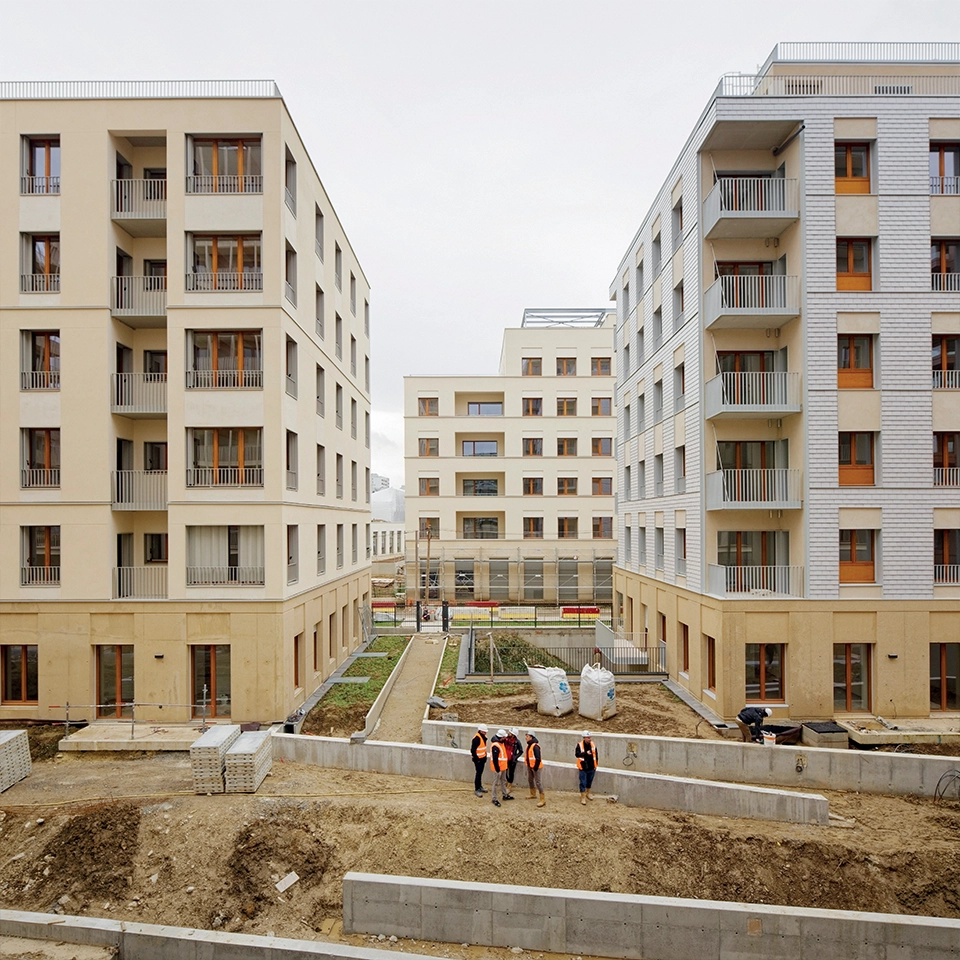
This project, managed by a consortium of Nexity and Eiffage Immobilier with CDC Habitat, EDF and Groupama, covered the development of Sector E – the Olympic Village Belvedere, which was divided into five works packages:
- 18 accommodation buildings (six 11-storey and twelve 6-storey blocks) containing a total of 527 apartments with a combined floor area of 39,420 m2.
- 13,491 m2 office building
- 4,611 m² of shops and businesses
- 452 m2 nursery school
- Parking level underneath the buildings
Designed to integrate with the city and the Plaine Commune area as a whole, this sector will have welcomed more than 2,500 athletes over the summer of 2024. The right choice of materials, control of CO2 emissions, and of course, reversibility, are key concerns for this single-site project.
-
52hectares
-
3 towns:Saint-Denis, Saint-Ouen and L’Île-Saint-Denis
-
2500athletes and para athletes and their support teams
Low-carbon construction
With overall responsibility for the project, Eiffage Construction brought together over 50 French companies in a nationwide low-carbon approach. During construction and operation, greenhouse gas emissions are continuously assessed to ensure compliance with the developer’s requirements and the certifications of excellence targeted by the project managers. Eiffage and its partners activated a number of levers to limit the environmental impact of this colossal project.
Re-use:
- Incorporation of at least 10% reused materials for four interior elements and three exterior elements.
- Re-use of around 75% of materials used for the Olympics in the reversibility phase.
- Use of biosourced and recycled materials.
Low-carbon materials:
- Structural elements of buildings incorporating low-carbon concrete or concrete-timber mix.
- 5% reduction in carbon footprint with recycled and repurposed materials compared with an equivalent solution.
- On-site Vicat concrete mixing plant to supply Eiffage Construction sites with low-carbon concrete.
Energy management:
- Innovative E3 tertiary building energy management combining solar power, electricity storage, and the use of electric vehicle batteries as energy sources.
-
80%of structural timber (excluding LVL) sourced from French forests
-
90%of timber FSC or PEFC certified (sustainably managed)
-
75%of materials used for the Olympics to be re-used in the reversibility phase
Biodiversity and urban revegetation
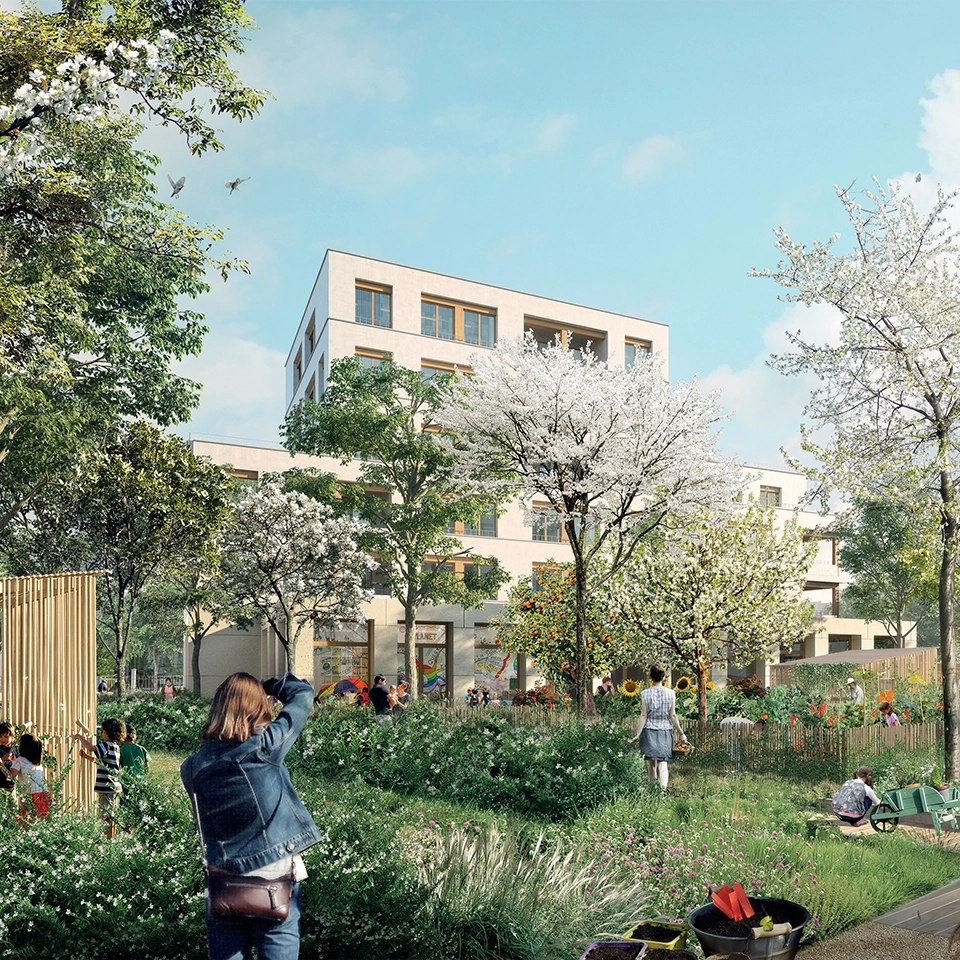
Vegetation plays a pivotal role, including with the creation of cool islands, 20% of all open space planted, and most rooftops vegetated, to minimise heat islands and be ready for climate change. From the ground to the rooftops, integrated landscaping is key. Local species abound, creating multiple environments: wild plant nurseries, traditional market gardens, wild flower meadows, etc. The landscaping also extends vertically, with wide balconies and accessible terraces. Nesting boxes and wildlife hotels were also installed on site. All these efforts will ensure that the programme as a whole achieves Biodivercity® Construction certification at the end of the Legacy phase.
Legacy 2025: reversibility is central to the project
Designed to offer its users an optimal quality of life in 2025, the Olympic and Paralympic Village is a full-size demonstrator of the city of the future. At the end of 2024, this 52-hectare site was transformed into a new city district with a population of 6,000 living in more than 2,500 homes, and created 6,000 jobs.
In total, 117,000 m2 of business premises were developed to accommodate offices and services, shops, nursery schools, educational establishments, sports facilities and an urban park. The priority is to meet the needs of local areas and their inhabitants.
Key dates
November 2024: reversibility works begin
July 2025: delivery of tertiary structures
September 2025: delivery and grand opening of housing